
Resource · Policy explainer
UPDATED JULY 19, 2026
The SAFER SKIES Act changed who can counter drones.
For the first time, state, local, Tribal, and territorial agencies can be trained, certified, and authorized to detect dangerous drones and, with advanced certification, stop them under their own authority.
This guide explains what the new framework says, what it means for agencies, and how to approach the first step.
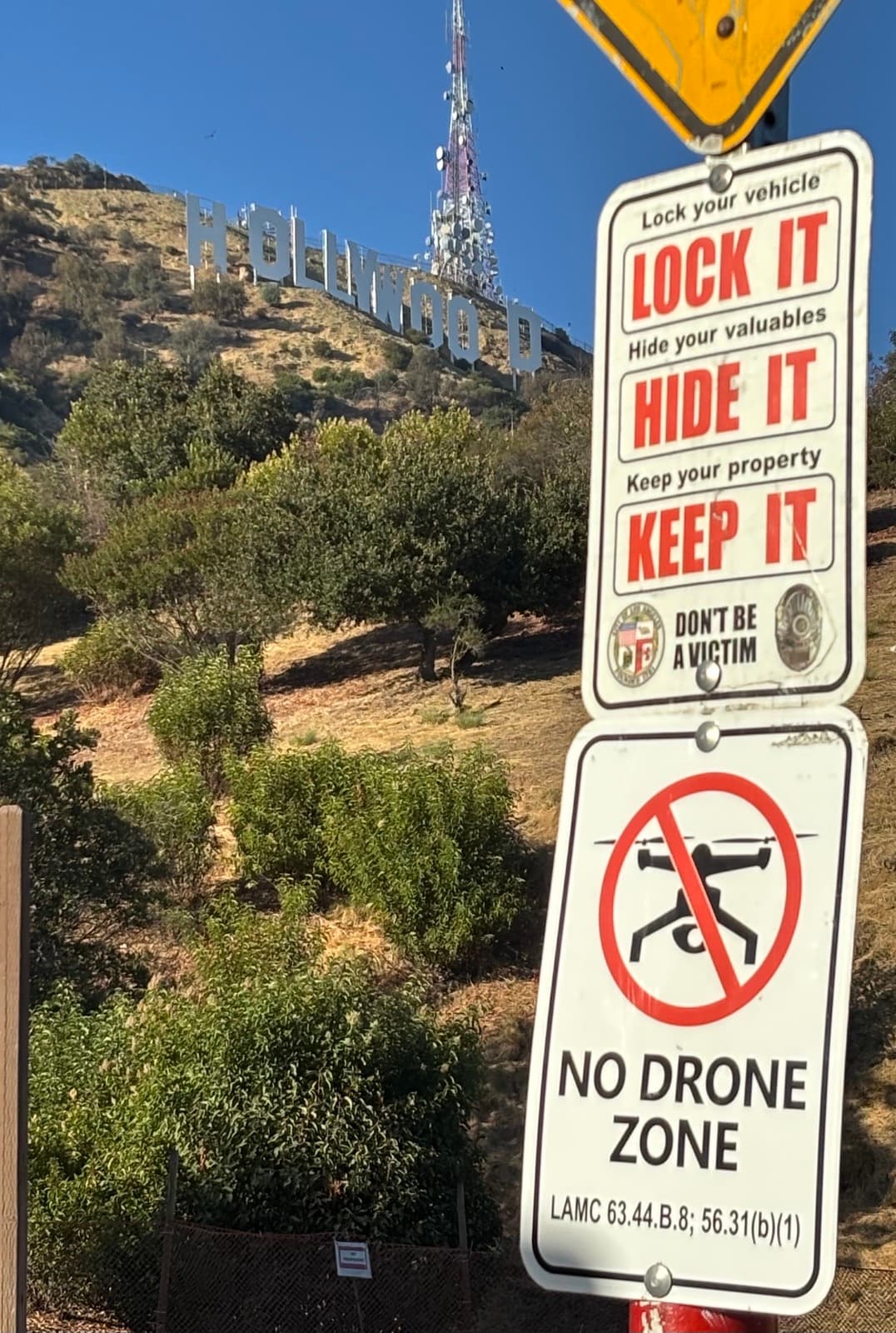
LOS ANGELES, CA · LAMC 63.44.B.8; 56.31(b)(1)
This is not legal advice. This page is a plain-language summary prepared by Guardian RF for general awareness. The controlling authority is the interim final rule at 91 FR 41466 and 6 CFR and 28 CFR Part 124. Agencies should consult counsel before making program decisions.
The United States government does not endorse Guardian RF or any other vendor. Nothing on this page implies otherwise.
The timeline
What the rule does
Until now, only a limited number of federal agencies could lawfully stop a dangerous drone.
Congress passed the SAFER SKIES Act in December 2025 to close that gap. The joint DOJ and DHS interim final rule, effective July 1, 2026, establishes the framework for eligible state, local, Tribal, and territorial agencies to exercise these authorities.
Participation is voluntary. Authority may be exercised only by an agency's own trained and certified officers, never by contractors, and operations are coordinated through an FBI-operated federal portal.
The framework creates two certification tiers.
Detection and Warning
Detection and Warning certification covers finding, tracking, identifying, warning, and seizing drones.
The certification requires a free online course lasting approximately 90 minutes and is designed for broad adoption across an agency workforce.
Mitigation
Mitigation certification covers disrupting, taking control of, disabling, or bringing down a threatening drone.
It requires a two-week resident course at the FBI's National Counter-UAS Training Center and carries substantially greater operational, legal, and coordination requirements.
Equipment is governed by two federal lists.
The Authorized Technologies List defines eligible technology categories. The Authorized Systems List identifies specific approved makes and models, with 21 systems listed at launch.
These lists apply to technologies that depend on the Act's legal protections, including control-link interception, protocol manipulation, and RF jamming.
Where passive detection fits
The rule draws its line at decoding the signal.
The SAFER SKIES Act governs counter-drone features that decode a drone's control link. Features that do not decode content are treated as they were before the Act.
Unrestricted, and usable today:
- ■Remote ID and ADS-B capture.
- ■Passive RF detection, fingerprinting, and classification that does not decode content.
- ■Locating the pilot or drone by signal bearing and energy alone.
Restricted, and available under certification:
Decoding the control link, which pulls a drone's ID, serial, telemetry, or a decoded pilot location out of the intercepted signal, along with analog FPV video reception, requires the Act's relief: a free, roughly one-hour Detection and Warning certification, a written detection-and-warning policy with portal attestation, an Operations Plan for each deployment, and equipment in a category on the Authorized Technologies List.
Guardian RF can sell, install, maintain, and train operators. By rule, our staff cannot operate restricted features or access captured content, and managed-service operation of those features is prohibited. Agencies run them under their own certification.
The practical path: field the unrestricted detection layer now, and add the decoded capabilities through a light, well-defined certification process as the mission requires.
Key figures
~1 hour
Free online Detection and Warning certification for restricted features.
$500 million
FEMA counter-UAS grant funding across fiscal years 2026 and 2027.
180 days
Maximum retention for control-communications records under the rule.
Sept 4, 2026
Public comment period closes for Docket FBI-2026-0001.
The funding
The FEMA Counter-UAS Grant Program provides $500 million across fiscal years 2026 and 2027.
The first $250 million was allocated to jurisdictions supporting the FIFA World Cup and America 250. The second $250 million is expected to open to all 56 states and territories this fall through State Administrative Agencies.
Detection and tracking capabilities are broadly eligible. Mitigation funding requires personnel trained through the National Counter-UAS Training Center.
Byrne JAG and COPS funding may also support authorized system purchases with prior Bureau of Justice Assistance approval.
For most agencies, the practical sequence is straightforward.
Stand up a passive detection layer first. Use the data to define the threat. Determine whether the activity justifies a certified program. Apply grant funding against a documented operational baseline rather than an assumption.
Have your say
The interim final rule is already in effect and remains open for public comment through September 4, 2026.
DOJ and DHS have specifically requested input on certification expiration, mutual-aid conditions, privacy requirements, and the penalty framework.
Agencies considering participation should review the rule's preamble and comment on the provisions that will directly affect their operations.
Getting started
Build your airspace baseline with passive detection.
Guardian RF passive sensors provide continuous airspace awareness and drone-pilot geolocation today.
They also create the documented baseline agencies need to make informed decisions about certification, mitigation, procurement, and grant funding.